OTC Genomics: Innovative Methods for environmental monitoring of aquatic habitats based on DNA sequencing
The project is now in the second phase (OTC Genomics 2)
The core research question of OTC Genomics 1 was whether we could use the composition of the microbial community in the Warnow estuary and the coast of the Baltic Sea as a measurement device for a wide range of chemical contaminants. More specifically, using the state-of-the-art in machine learning and artificial intelligence, as well as DNA-based and chemical analyses, we have worked to identify microbial bioindicators for pharmaceuticals, herbicides and UV filters -- and are in the process of creating user-friendly tools that make these insights available to the public.
This goal entails the two intertwined aspects of OTC Genomics 1. Firstly, we established a hybrid sampling-and-data-analysis pipeline with a high degree of automation and an emphasis on throughput. This means the integration of automated sampling devices (as provided by HYDRO-BIOS Apparatebau GmbH), 16s and 18s amplicon sequencing (LGC Genomics GmbH), bioinformatics and HPLC-MS/MS analyses (IOW), with a central, dynamically responsive database, that then feeds the machine learning (IOW) and AI models (Planet AI GmbH) as well as the graphical representation of the data (Fraunhofer IGD). The stated goal of the project was to be able to go from sample to insight in 2-3 weeks in a reproducible manner while balancing automation with the iterative interactions between the project partners.
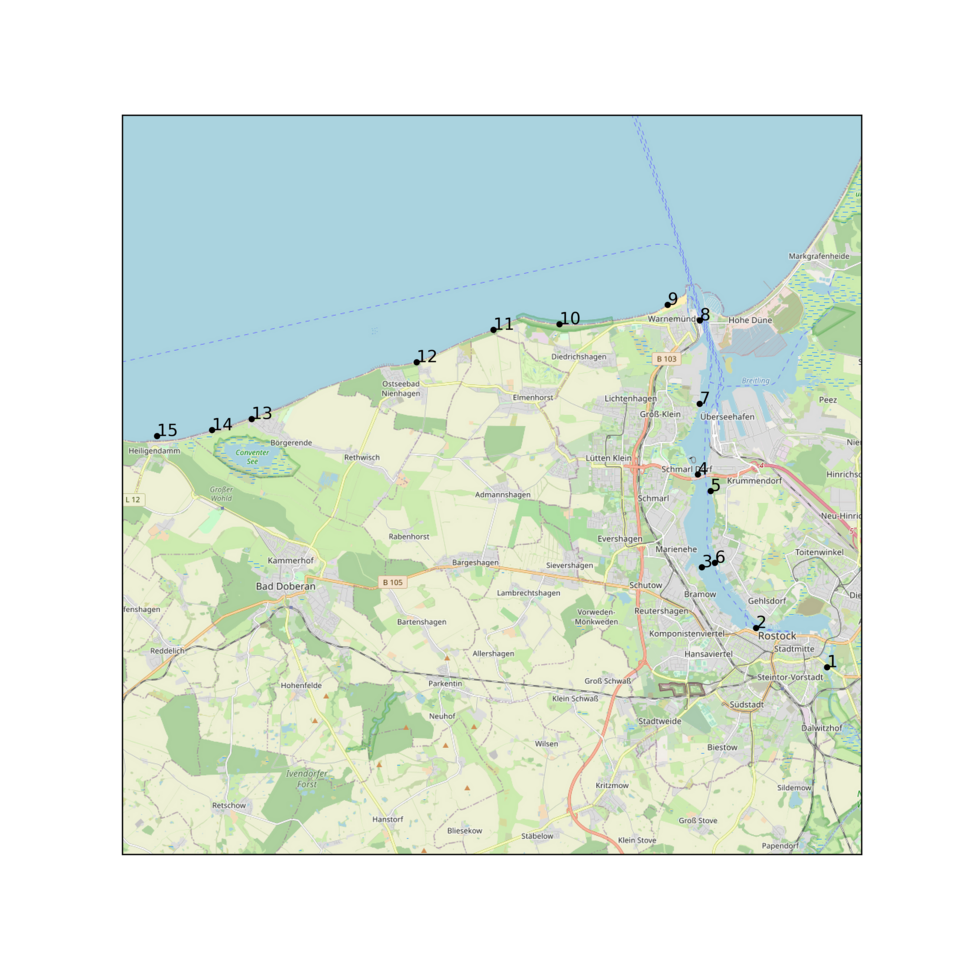
Because the machine learning and AI models that have been created and are being further developed by OTC Genomics require large amounts of data to identify relevant patterns in the data, the second aspect was a large-scale sampling scheme. Starting in April 2022, we sampled fourteen points across the Warnow estuary and the Baltic Sea coast (see the map) twice a week for just over one full year. In order to be able to compare our results to those of the long-running Heiligendamm biomonitoring, we also continue to sample this point once a week. In this way, we have created one of the longest sequencing-based time series dataset available to date with a high temporal and spatial resolution.
This sequencing did not halt with the start of OTC genomics 2, but instead shifted focus. Working with the Landesamt für Umwelt, Naturschutz u. Geologie (LUNG) in Mecklenburg Vorpommern, samples of rivers and lakes have continued to be processed with the goal of determining the power of eDNA for biomonitoring and water quality assessment. In addition to this, in the continuing partnership with PlanetAI, powerful interactive tools are being developed to enable data analysis and visualisation without the need for significant scientific expertise.
OTC Genomics is part of OTC Rostock.
OTC Genomics is funded by the Bundesministerium für Forschung, Technologie und Raumfahrt.