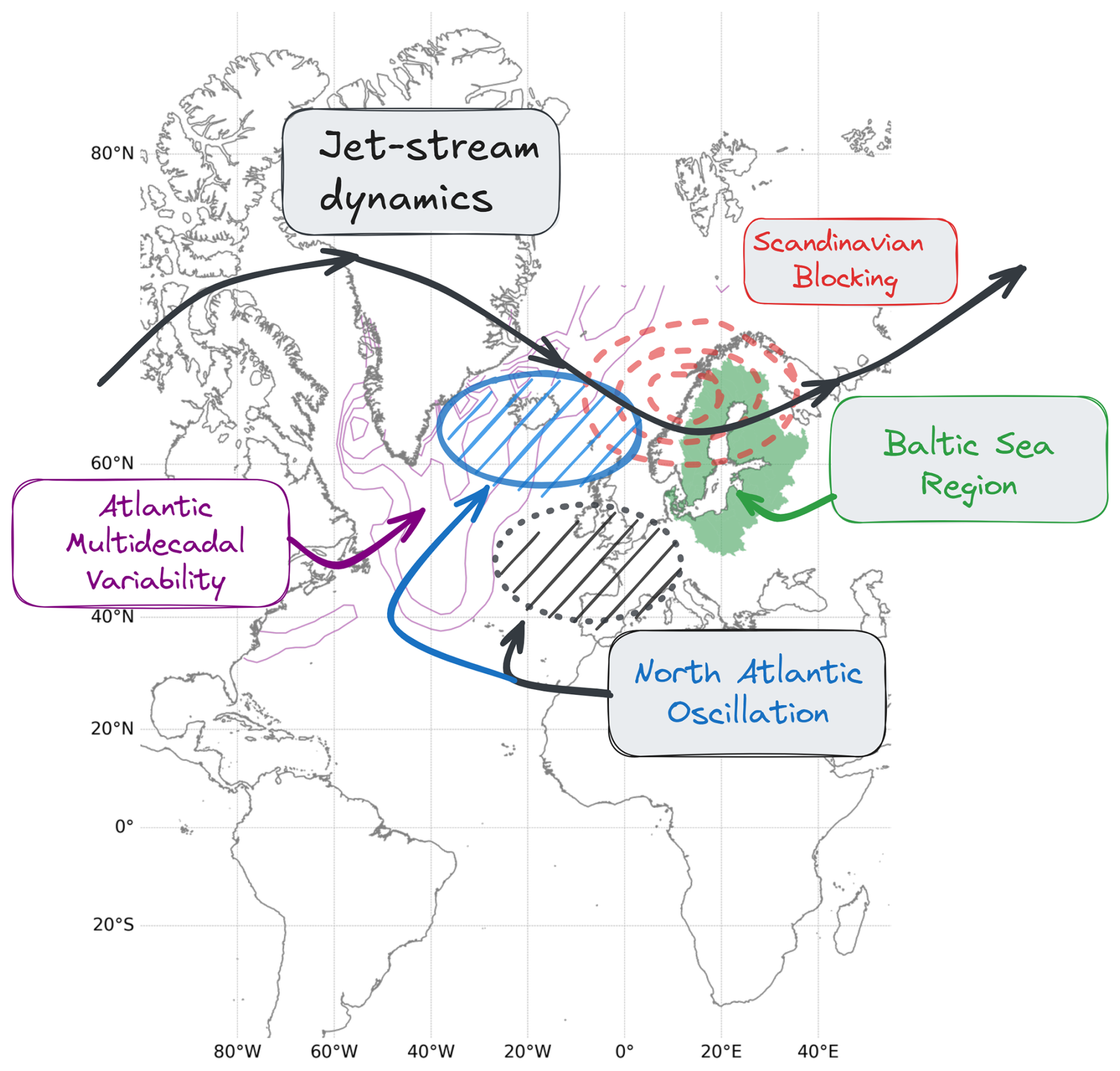
The Junior Research Group investigates the internal and external drivers of climate variability, with a particular focus on large-scale circulation, decadal to multi-decadal variability, and the regional expression of these signals in the Baltic Sea and Northern Europe. We combine process understanding, climate modelling, and data-driven approaches to improve our understanding of long-term predictability, extreme events, and their impacts on marine and coastal systems.
Our primary regional focus is the Baltic Sea – one of Europe’s most socioeconomically sensitive marine regions – while extending this research to other coastal seas.
Figure 1: ICON-Coast grid and examples of coastal systems worldwide experiencing hypoxia. Bathymetry from GEBCO, interpolated to the native ICON-Coast grid. Adapted from Fennel and Testa (2019).
A growing focus of the group is the translation of large-scale climate information into regional and coastal applications. In this context, we contribute to the IOW-led SeaGuard project, which combines regional climate modelling, optical remote sensing, and machine-learning approaches to identify climate-resilient restoration areas and assess the future potential of seagrass meadows under changing environmental conditions.
Key Research Areas
Understanding Climate Variability
We investigate the mechanisms behind decadal and multi-decadal climate variability and how large-scale climate signals shape marine and coastal conditions in the Baltic Sea and Northern Europe. Particular attention is given to teleconnections between the North Atlantic and the Baltic Sea and their regional consequences.
Extreme Events and Predictability
We study climate-related extremes, including marine heatwaves and other high-impact events, and assess their predictability from seasonal to decadal timescales. This includes understanding how extreme events emerge from – or deviate from – the background of natural climate variability.
Oxygen Variability and Marine Biogeochemistry
We examine how circulation changes, inflow dynamics, and climate variability affect oxygen conditions and biogeochemical processes in the Baltic Sea. This work contributes to a better understanding of hypoxia, ventilation, and ecosystem-relevant changes in marginal seas.
Regional Climate Projections and Coastal Applications
We use regional and high-resolution model systems to assess future environmental conditions in vulnerable coastal systems, including the Greifswalder Bodden. A central goal is to strengthen the scientific basis for assessing seagrass persistence, restoration potential, and coastal climate adaptation under changing climate and nutrient conditions.