
Press Releases
Planetary Health Check 2026: Why a healthy seafloor matters for the Earth system
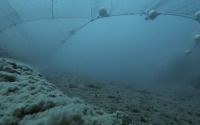
The seafloor is habitat, carbon sink and a hub for global matter cycles, yet human influence nowadays reaches from the coast all the way to the deep sea. Fishing, mining, shipping and infrastructure threaten ecosystems, stir up sediments and mobilise stored carbon. With a new chapter on seafloor integrity – compiled by researchers from the IOW, Kiel University (CAU) and the Potsdam Institute for Climate Impact Research (PIK) – the Planetary Health Check 2026 for the first time focuses comprehensively on the threats to the seafloor and its significance for the Earth system.
» Read more … Planetary Health Check 2026: Why a healthy seafloor matters for the Earth system
Reading ecosystems like a book: AI method reveals hidden patterns in microbial communities in the Warnow
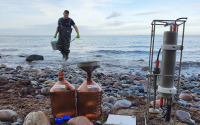
Microbial communities are highly sensitive to environmental changes, yet their enormous diversity makes it difficult to identify ecological patterns. A research team from the IOW has now shown that an AI method originally developed for text analysis can be successfully applied to the analysis of complex environmental samples. The method identified five seasonally successive microbial sub-communities in the Warnow estuary while preserving ecological and functional information just as well as conventional methods – in some cases they even performed better.
A coral’s Swiss Army knife: The numerous powers of cilia
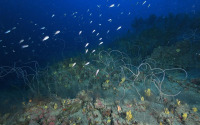
An international research team led by scientists from the Max Planck Institute for Marine Microbiology in Bremen and the IOW investigated how the shape of black corals influences the functions of their cilia. By combining an unusually comprehensive suite of imaging and microsensor techniques, the researchers were able to visualize both, water flow and oxygen transport, from individual cilia to entire coral fragments. They found that the cilia allow corals to create and direct the flow of water around and within them, thus optimising oxygen supply, feeding and internal transport. The study was recently published in Communications Biology.
» Read more … A coral’s Swiss Army knife: The numerous powers of cilia
IOW research uses AI and drones to improve early warning systems for Vibrio bacteria in the Baltic Sea
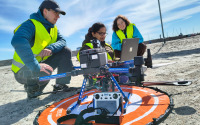
The presence of the marine bacterium Vibrio vulnificus, which is potentially dangerous to humans, can now be predicted up to five weeks in advance in the Baltic Sea using artificial intelligence (AI). A research team led by the IOW reached this conclusion by combining high-resolution environmental, satellite, and microbiome data in an AI-based analysis. The study, recently published in “Water Research,” shows that this approach allows for a much more precise identification of risk periods than was previously possible.
Inland seas around the world are severely affected by climate change

Under the lead of the Leibniz Institute for Baltic Sea Research Warnemünde (IOW), climate simulations were used to investigate how 19 inland seas, including the Baltic Sea, are responding to climate change. The researchers found that they have been warming faster than the global ocean since the 2000s. Projections show that marine heatwaves will affect around 60% of these seas on an annual average basis as early as in the middle of the 21st century. Without adherence to the Paris Agreement targets, up to 90% of these seas would be affected by heatwaves. The study contributes to climate change management practices and was published in the journal Communications Earth & Environment.
» Read more … Inland seas around the world are severely affected by climate change
Media and public relation contact:
Dr. Kristin Beck
Tel.: 0381 5197 135
Dr. Sonja Ehlers
Tel.: 0381 5197 109
General e-mail:
presse@iow.de