
Press Releases
International scientists gather in Germany for Baltic Earth Conference
Every two years, the international research network Baltic Earth organizes a conference in a Baltic Sea coastal state, bringing together scientists working on a wide range of topics related to the Baltic Sea region. This year, the conference is held in Heringsdorf on the island of Usedom, Germany, from April 13 – 17, 2026, and co-organized by the IOW and Institute of Oceanology, Polish Academy of Sciences (IOPAN). The conference has been endorsed as a UN Ocean Decade Activity, highlighting its role in advancing ocean science and supporting sustainable solutions for the marine environment.
» Read more … International scientists gather in Germany for Baltic Earth Conference
Why the eutrophicated Baltic Sea struggles with recovery – New IOW review highlights key processes and causes
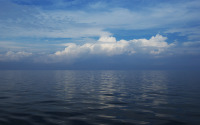
The Baltic Sea has been under pressure for decades: Although phosphorus and nitrogen river loads, the main cause for its eutrophication, have been significantly reduced, adverse effects such as algal blooms and oxygen depletion still massively occur, leading to further ecological problems. Scientists at the IOW have now published a comprehensive review showing how nutrient pollution, internal matter cycles and global warming interact, thereby delaying the impact of protective measures. They also identify potential approaches for effective Baltic Sea management. The study was recently published in the Annual Review of Marine Science.
Underestimated wake: Shipping traffic causes more turmoil in the Baltic Sea than expected
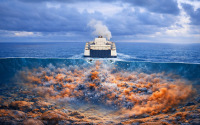
Commercial shipping not only affects the Baltic Sea on the surface, but also has a significant impact on the water column and the seabed. A study by the IOW and Kiel University (CAU) now shows for the first time that wake turbulence from large ships in heavily trafficked areas of the western Baltic Sea significantly alters water stratification and leads to marked sea floor erosion.
Record low sea levels in the Baltic Sea – Will there be a major inflow of saltwater from the North Sea?
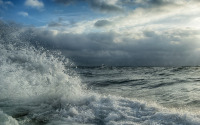
Since the beginning of January, an unusually long period of easterly winds has caused the average water level in the Baltic Sea to fall to a historic low. Measurements at the Swedish Landsort-Norra gauge show values that are the lowest since records began in 1886. Researchers at the IOW are currently monitoring this development very closely, as it represents a rare oceanographic situation that could lead to a large inflow of saltwater from the North Sea into the Baltic Sea.
From Greenland to the deep sea via ocean express: North Atlantic Seaweed has potential as major carbon trap
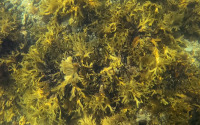
Greenland’s coastal macroalgal forests may be a far more significant contributor to global carbon storage than previously thought. That is the outcome of a new study co-led by the IOW and the Helmholtz-Zentrum Hereon. By combining satellite imagery, ocean drifter trajectories, and high-resolution ocean turbulence models, the international research team demonstrated, how ocean currents and intense mixing events act to push seaweeds – and thus the carbon in their tissues – into the deep ocean.
Media and public relation contact:
Dr. Kristin Beck
Tel.: 0381 5197 135
Dr. Sonja Ehlers
Tel.: 0381 5197 109
General e-mail:
presse@iow.de