
Team
Lead:

Senior Scientists:
Post-Docs:
PhD students:
Technicians:
Master students:
Ella Danae Schorling
WG Geomicrobiology
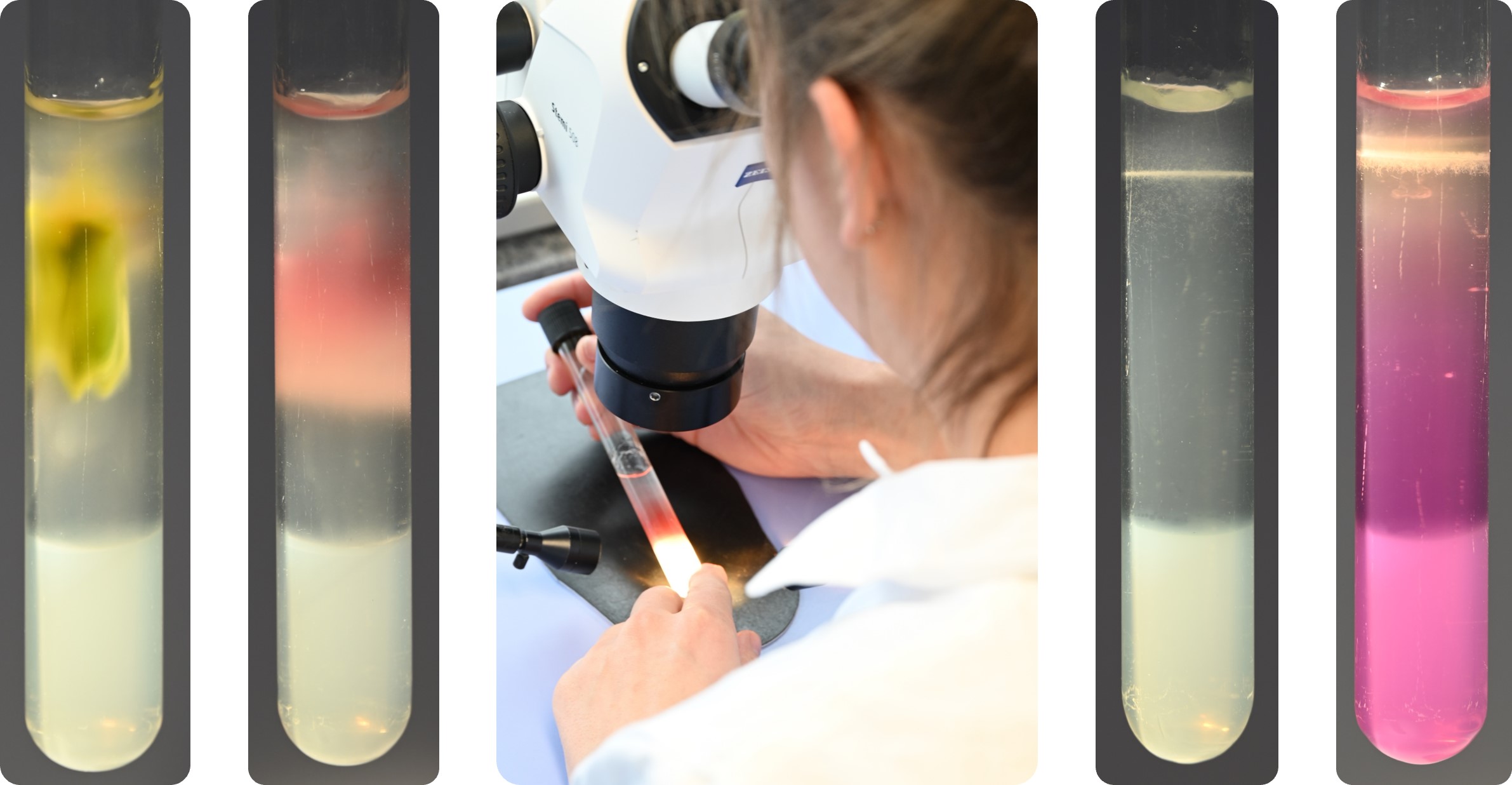
In our working group "Geomicrobiology", we investigate how microorganisms shape their environment – with a particular focus on sulfur-oxidizing bacteria, which occupy very specific niches thanks to their extraordinary physiological adaptations. These include, for example, particularly large sulfur bacteria of the Beggiatoaceae family, highly mobile magnetotactic bacteria of the genus Magnetococcus, and manganese-reducing sulfur oxidizers of the genus Sulfurimonas.
Geographically, we work primarily in the two largest brackish seas on Earth – the Baltic Sea and the Black Sea – as well as in marine sediments of upwelling areas, coastal sands, and mudflats. We are particularly interested in oxic-anoxic boundary layers, both in the pelagic and benthic zones, where these microorganisms live and control key biogeochemical processes. We examine their role in the cycles of sulfur, nitrogen, and phosphorus.
We combine fieldwork and laboratory studies: In the laboratory, we enrich microorganisms, isolate and cultivate them, and conduct targeted experiments to understand their physiology and interaction with the environment. Using microsensors and nutrient analyzers, we record the subtle chemical gradients in which these organisms reside. We also use microscopy and a wide range of molecular methods—from genome sequencing of enrichments and isolates to metabarcoding and meta-omics of laboratory and field samples. In this way, we bridge the gap from individual cells to large-scale material flows in marine ecosystems.