
Press Releases
Fungi Infect Nitrogen-Fixing Cyanobacteria

Under the lead of the Leibniz Institute for Baltic Sea Research Warnemünde (IOW) the influence of parasitic fungi on the physiology and survival of cyanobacteria in the Baltic Sea was investigated. Such infections are known from lakes. Due to the high nutrient load in the Baltic Sea, there are high levels of cyanobacteria, some of which are toxic (algal blooms). In addition, the decomposition of algal blooms leads to oxygen depletion. Cyanobacteria are important for the nitrogen cycle, as some fix nitrogen and thus further increase nutrient concentrations in the Baltic Sea. The findings were recently published in the journal Nature Communications.
More eelgrass in the Baltic Sea thanks to AI – Kick-off meeting for SEAGUARD research project at the IOW
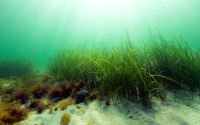
How can eelgrass beds in the Baltic Sea be efficiently restored with the help of artificial intelligence (AI) in the most climate-resilient way possible? This is the core question of the new SEAGUARD research project, which is coordinated by the IOW. The project combines marine research, data science and environmental management and is funded with about 1.8 million euros until November 2027 as part of the German federal environment ministry's AI flagship initiative.
The Baltic Sea coast in the Anthropocene: a model for the consequences of climate change
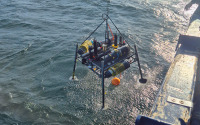
Under the lead of the IOW, a review article outlined the state of the Baltic Sea coast and its expected development as a result of climate change. The article shows that the Baltic Sea can serve as a model for the consequences of climate change and that interdisciplinary research is needed to investigate changes in its shallow coastal zones.
» Read more … The Baltic Sea coast in the Anthropocene: a model for the consequences of climate change
Climate change promotes the spreading of vibrios: IOW study reveals global distribution patterns
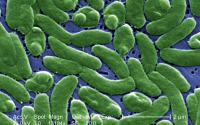
Vibrio vulnificus, a bacterium that is potentially very dangerous to humans, is a natural component of marine plankton. The IOW has now presented the first comprehensive analysis of its global distribution. It shows that the pathogen occurs in almost all coastal regions of the world, but is more prevalent at comparatively high water temperatures, moderate salinity levels, and in decaying algal blooms. The study also provides a predictive model that can be used to estimate future climate change-induced changes in the distribution of vibrios.
Sediment cores from the Southeast Pacific as an 8-million-year-old climate archive: Temperature influences global ocean currents
Under the lead of the IOW, a sediment core from the Southeast Pacific was examined that reflects the last 8 million years of Earth's history. The study shows that the intensity of the Antarctic Circumpolar Current, which connects the world’s three major oceans, is particularly sensitive to temperature changes, which in turn significantly influences the exchange of CO2 between the ocean and the atmosphere.
Media and public relation contact:
Dr. Kristin Beck
Tel.: 0381 5197 135
Dr. Matthias Premke-Kraus
Tel.: 0381 5197 102
Dr. Sonja Ehlers
Tel.: 0381 5197 109
General e-mail:
presse@iow.de