
 |
IOW · NewsletterDecember 2025 |
|---|
| Newsletter online: en | de | ||
Content |
||
|
News » Annual report 2024 » Fish dying off Warnemünde » TEQ recertification successful » New IOW Data Policy » New Projects » ISOLUME » SEAGUARD » RIVIERADE » Benthos monitoring in the Baltic Sea » Careers » Summer school 2025 » Ship expeditions » Expedition EMB 373 » Forthcoming event » 6th Baltic Earth Conference 2026 » Publications » Sediment cores from the Southeast Pacific » Salinization threatens water supplies worldwide » The Baltic Sea coast in the Anthropocene » Climate change promotes spread of vibrios » Biological Assessment of the Baltic Sea 2024 » Jobs » Full Professorship for Marine Chemistry |
||
Science Diplomacy in Baltic Sea Research |
||
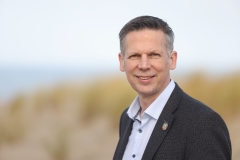
Current global political tensions are having a direct impact on the conditions for scientific work. This is also evident in the Baltic Sea region: while cooperation with one of the riparian states is currently at a complete halt, this cooperation remains all the more important between the other partners in order to reliably understand ecological developments in a shared marine area. Science diplomacy provides the necessary framework for this – and shapes the daily work of the IOW. It encompasses diplomacy for science, i.e., international agreements that enable access to research areas, ship deployments, and data exchange; science for diplomacy, where the IOW acts as a neutral partner to maintain stable scientific dialogue between institutions in different countries; and science in diplomacy, where our data and analyses serve as a basis for decisions on environmental conditions, monitoring, or climate impacts in international committees. In this context, research security is also becoming increasingly important. The European Flagship Event of the same name, at which I had the opportunity to speak on the panel in September, and the position paper published by the German Council of Science and Humanities in May, “Science and Security in Times of Global Political Upheaval,” make it clear that scientific openness and necessary protective measures need to be rebalanced—especially in international collaborations. For the IOW, this means shaping scientific cooperation responsibly: sensitive to risks, clear in its processes, and at the same time open enough to secure and further develop the common knowledge base for the Baltic Sea region. Our teams in research, monitoring, and transfer work with this aspiration in mind. The following articles provide an overview of key developments and results from the past six months at the IOW – from research as well as from cooperation with partners in the region and beyond. I hope you find this an enlightening read. 
Oliver Zielinski | Director |
||
 |
||
News |
||
IOW annual report 2024 |
||
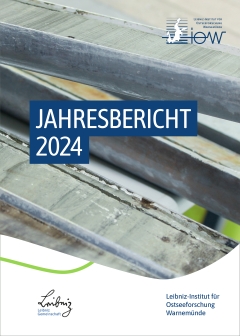 |
The 2024 annual report is now available. In it, we present research highlights from the past year, special achievements by colleagues, and the IOW's involvement in various areas. |
|
Oxygen deficiency as the cause of fish deaths near Rostock in September 2025 |
||
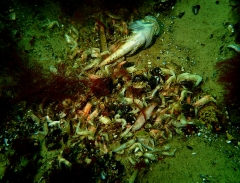 at the coast near Rostock (Photo: E. Hildebrandt) |
Between September 26 and 28, 2025, a large number of dead fish washed up on the beaches of Nienhagen, Warnemünde, and Markgrafenheide. The event sparked intense debate in the region and beyond. The IOW was able to contribute to the objectivity of the debate quickly and with well-founded facts. » read more ... |
|
IOW recognized for sustainably established equal opportunities |
||
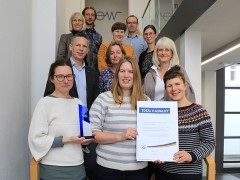 |
On November 4, 2025, the IOW was awarded the TOTAL E-QUALITY seal of approval for the fifth time for its exemplary and sustainably anchored work in the field of equality and diversity. The seal of approval, which is awarded for three years, recognizes organizations that are particularly committed to equal opportunities, diversity, and inclusion. |
|
New IOW Data Policy |
||
|
A new IOW Data Policy has been adopted at the end of October 2025. It forms the basis for a transparent, open and FAIR handling of the research data generated at our institute and has the specific aim of ensuring access, interpretability and reproducibility of the research outcomes. The IOW Data Policy provides, inter alia, recommendations for the use of the internal data infrastructure. |
||
New Projects |
||
European research initiative investigates changing underwater light conditions |
||
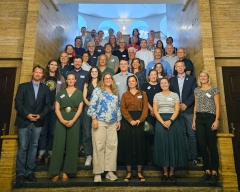
(Photo: S. Schopen / IOW) |
The international “Research Initiative on Altered Marine Light Landscapes” was launched on September 10, 2025. The initiative aims to improve understanding of altered light conditions in the ocean and their consequences for marine ecosystems. Two projects are starting work under the umbrella of a joint knowledge platform. The ISOLUME project focuses primarily on ocean darkening and is coordinated by the IOW. Duration: 01.07.2025 - 30.06.2028 · Contact: Oliver Zielinski · Funding: EU - Horizon Europe 2021-2027 (JPI Oceans) » to the press release ... |
|
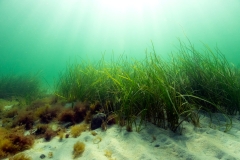
More seagrass in the Baltic Sea thanks to artificial intelligence |
||
|
How can seagrass beds in the Baltic Sea be renaturalized as efficiently and climate-resiliently as possible with the help of artificial intelligence (AI)? This question is at the heart of the SEAGUARD research project. The project brings together marine research, data science, and environmental management. Duration: 01.07.2025 - 31.12.2027 · Contact: Florian Börgel · Funding: BMUKN - Bundesministerium für Umwelt, Klimaschutz, Naturschutz und nukleare Sicherheit » to the press release ... |
|
Modeling methods for climate services for resilient oceans |
||
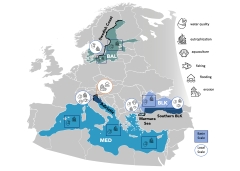
(Source: Istituto Nazionale di Oceanografia e di Geofisica Sperimentale) |
Providing validated climate services for a resilient European sea over a time span of decades to several decades is a challenge. RIVIERADE brings together the scientific communities of CORDEX and the Copernicus Marine Service and leverages their unique scientific expertise to develop and implement a pre-operational and reproducible multi-model framework and protocols. Duration: 01.01.2026 - 31.12.2029 · Contact (IOW): Markus Meier · Funding: EU - Horizon Europe 2021-2027 » read more ... |
|
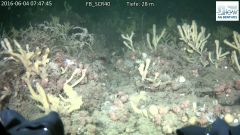
Long-term benthos monitoring in the Baltic Sea |
||
|
The IOW‘s benthos monitoring in the Baltic Sea has been consolidated. On behalf of the BfN, a working group led by Michael Zettler will permanently document and model the development of benthos populations in the Fehmarnbelt, sKadetrinne, Adlergrund/western Rönnebank, and Oderbank protected areas. Duration: 01.10.2025 - 30.09.2035 · Contact (IOW): Michael Zettler · Funding: BfN - Bundesamt für Naturschutz » read more ... |
|
Careers |
||
11th Baltic Earth summer school |
||
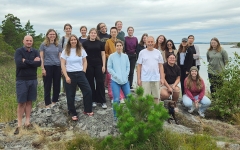
(Photo: E. Lindell / Askö Laboratory) |
From August 18 to 25, 2025, the Baltic Earth research network held its eleventh summer school. The venue was the field station of the Stockholm University Baltic Sea Center on the Swedish archipelago island of Askö. Since 2015, the summer school has been organized at the Askö research station by Markus Meier, IOW expert on the Baltic Sea climate, and the International Baltic Earth Secretariat (IBES). |
|
Ship expeditions |
||
Research trip to study shallow coastal waters |
||
|
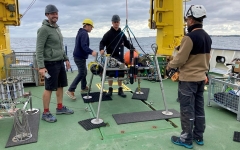
On August 19, 2025, the research vessel Elisabeth Mann Borgese set sail on a two-week expedition (EMB373) to the western Baltic Sea. The expedition was the first voyage conducted as part of the IOW's research into shallow water processes and their relevance for the entire Baltic Sea (Shore to Basin, S2B). |
|
Forthcoming event |
||
| 📅 13.04.2026 - 17.04.2026 | ||
6th Baltic Earth Conference 2026 |
||
|
The Baltic Earth Network is organising the 6th Baltic Earth Conference from 13 to 17 April 2026 |
||
Publications |
||
Sediment cores from the Southeast Pacific as an 8-million-year-old climate archive: Temperature influences global ocean currents |
||
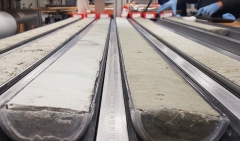 |
Sediment cores from the southeast Pacific were examined that reflects the last 8 million years of Earth's history. The study shows that the intensity of the Antarctic Circumpolar Current, which connects the three major oceans, is particularly sensitive to temperature changes. Reference:
Wegwerth, A., H. W. Arz, J. Kaiser, G. Winckler, L. Lembke-Jene, V. Rigalleau, N. Ruggieri, H. Sadatzki and F. Lamy (2025). South Pacific sea surface temperature and global ocean circulation changes since the late Miocene. Nat. Commun. 16: 6593.
http://dx.doi.org/10.1038/s41467-025-62037-w Contact: Antje Wegwerth
|
|
Salinization threatens water supplies from tidal rivers worldwide |
||
|
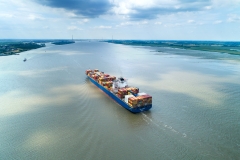
Water extracted from tidal rivers for human use is threatened by salinization worldwide. This is the result of a recent study by an international research team led by the University of Maryland in the US, which has now been published in the journal Environmental Science & Technology Letters and in which the IOW was also involved. Reference:
Li, M., R. G. Najjar, S. Kaushal, A. Mejia, R. J. Chant, D. K. Ralston, H. Burchard, A. Hadjimichael, A. Lassiter and X. Wang (2025). The Emerging Global Threat of Salt Contamination of Water Supplies in Tidal Rivers. Environ. Sci. Technol. Lett.
http://dx.doi.org/10.1021/acs.estlett.5c00505 Contact: Hans Burchard
|
|
The Baltic Sea coast in the Anthropocene – a model for the consequences of climate change |
||
|
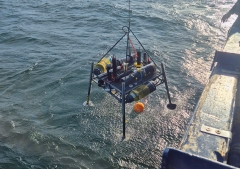
A review article outlined the state of the Baltic Sea coast and its expected development as a result of climate change was published by an interdisclipinary IOW team. The article makes it clear that the Baltic Sea can serve as a model for the consequences of climate change and that interdisciplinary research is needed to investigate changes in its shallow coastal zones. One focus here is on researching the interactions between the coastal area and the open sea. Reference:
Voss, M., P. Holtermann, S. Ahmerkamp, D. L. Arévalo Martínez, B. Cahill, M. Chouksey, J. W. Dippner, J. Dutz, P. Feldens, J. Geersen, K. Gentsch, M. Gogina, D. Herlemann, J. Henkel, M. Kanwischer, B. Krebs, A. Kremp, A. Malissery, R. Mars, J. Müller, S. Neubert, H. Osterholz, H. Radtke, G. Rehder, K. Romoth, M. Sass, I. Sassenhagen, O. Schmale, M. v. Thenen, M. v. Weber and O. Zielinski (2025). Coastal zones of the Baltic Sea in the Anthropocene: Current state and the impact of climate change. Estuar. Coast. Shelf Sci. 326: 109504.
https://doi.org/10.1016/j.ecss.2025.109504 Contact: Maren Voß, Peter Holtermann
|
|
Climate change promotes spread of vibrio bacteria:
|
||
|
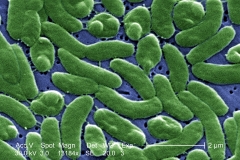
Vibrio vulnificus, a pathogen that causes gangrene and is potentially dangerous to humans, is a natural component of marine plankton. The IOW has now presented the first comprehensive analysis of its global distribution. This shows that the pathogen occurs in almost all coastal regions of the world, but proliferates at comparatively high water temperatures, moderate salinity levels, and in dying algal blooms. Reference:
Riedinger, D. J., C. Hassenrück, D. Herlemann and M. Labrenz (2025). Global distribution and predictive modeling of Vibrio vulnificus abundance. Commun. Earth Environ. 6: 210.
https://doi.org/10.1038/s43247-025-02182-8 Contact: Matthias Labrenz, Christiane Hassenrück
|
|
Biological Assessment of the Baltic Sea 2024 |
||
of the Baltic Sea 2024 |
The Biological Assessment Report of the Baltic Sea for 2024 has been published in the Marine Science Reports. Reference:
Zettler, M. L., J. Dutz, A. Kremp, C. Paul, S. Busch, M. Naumann and S. Kube: Biological assessment of the Baltic Sea 2024. Meereswiss. Ber., Warnemünde, 131 (2025).
https://doi.iow.de/10.12754/msr-2025-0131 Contact Coordination team IOW long-term observation program: Joanna Waniek, Sandra Kube, Michael Naumann
|
|
Jobs |
||
|
Closing date is 31 December 2025. |
||
| Jobs | Data Protection | Legal Notice | Contact | ||
|
If you would like to receive our newsletter regularly from now on you can register here. If you no longer wish to receive our newsletter you can unsubscribe here |
||