
Research Area 2: Coastal Seas in Transition:
Present, Past & Future Perspectives
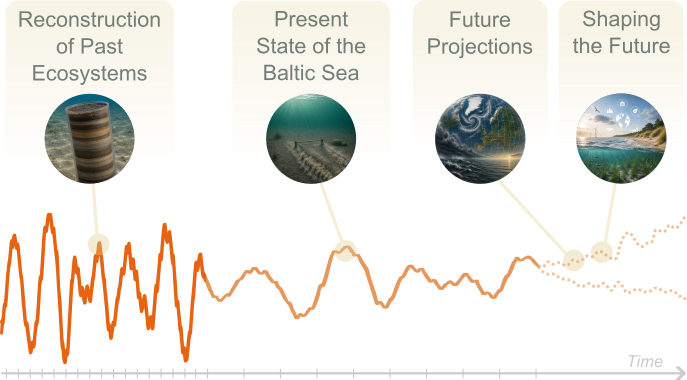
Our coastal seas are dynamic systems, and only by recognizing natural variability and its implications, we can disentangle the antropogenic impacts that superimpose the natural background. Across disciplines, we address the past and present conditions to inform future developments of the Baltic Sea ecosystem, and strengthen our focus on the hotspots of climate change: the Northern Baltic and the shallow water regions. From the present state of the Baltic Sea system (RA 2.1), the reconstruction of past ecosystem conditions (RA 2.2), and future projections under changing climate and human impact (RA 2.3), we aim to develop the knowledge needed to shape the coastals sea's future (RA 2.4) in order to reach a good environmental status.
Here is a short list of the most recent publications of the research area and recently funded projects. The full list can be found under RA2 publications and RA2 projects, respectively.
Recent publications
- Wolf, F., L. A. Schulz, O. Thiele, S. Ahmerkamp, P. Holtermann, K. Attard and M. L. Zettler (2027). Carbon fluxes within an Arctica islandica habitat in the German Baltic Sea. Estuar. Coast. Shelf Sci. 344: 110306, doi: 10.1016/j.ecss.2026.110306
- Schulz, L. A., K. Kniesz, H. Stuckas, F. Wolf and M. L. Zettler (2026). Mitochondrial diversity and demographic history of Arctica islandica (Bivalvia: Venerida) in the German waters of the Baltic Sea. Sci. Rep. 16: 33025, doi: 10.1038/s41598-026-76449-1
- Sakpal, H., M. Kanwischer, D. E. Schulz-Bull, A. Philippe and K. Fisch (2026). Spatio-temporal patterns and transport pathways of UV filters in the Western Baltic Sea. Emerg. Contam.: 100756, doi: 10.1016/j.emcon.2026.100756
Recent projects
-
PrimePrevention-2:
DAM Extrem-2: PrimePrevention-2 Vorhersage mariner biologischer Gefahren zur Verhinderung sozioökonomischer Auswirkungen, Vorhaben: Verbesserte Bewertungs- und Entscheidungsgrundlagen für biologische Gefahren in den Küstengewässern der westlichen Ostsee
BMFTR - Bundesministerium für Forschung, Technologie und Raumfahrt (01.01.2027 - 31.12.2029) -
ClimPact:
Glacial-interglacial climate dynamics in the Subantarctic Eastern South Pacific since the late Miocene – high-resolution temperature reconstructions during the last 8 Ma
DFG - Deutsche Forschungsgemeinschaft (15.04.2026 - 14.04.2028) -
RIVIERADE:
Improving Modelling Methods to Produce Climate Services for Resilient European Seas and Coasts in a Decadal to Multi-Decadal Horizon
EU - Horizon Europe 2021-2027 (01.01.2026 - 31.12.2029)
RA 2.1: The present state of tha Baltic Sea system
We investigate ecosystem variability, trends and threats on decadal timescales. The IOW long-term observation programme is an indispensable tool for identifying patterns, trends or shifts of the environmental state and at the same time forms the basis for modeling future scenarios of the ecosystem in a changing environment. Besides natural variability of the system, the interdisciplinary research focuses on the causes, effects, and future development of anthropogenic impact including the state of eutrophication, deoxygenation and pollution.
RA 2.2: Reconstruction of past ecosystems
We focus on the environmental and climate reconstruction of past ecosystem conditions to inform the future. We develop indicators (or proxies) and dating tools for sediment cores that are needed to produce high-quality paleoenvironmental reconstructions of e.g. water temperature, salinity, productivity or oxygenation. The internal variability of such parameters can be assessed by conducting ensemble simulations with global and regional, fully coupled ocean-atmosphere models at multi-decadal to multi-millenial timescales. In turn, the paleoenvironmental records can be used to evaluate and validate climate simulations.
RA 2.3: Future projections under changing climate and human impact
As important drivers of climatic and environmental change are located far removed from the Baltic Sea region, the influence of the North Atlantic and Arctic Sea has to be taken into account to identify the main modes of natural climate variability and their changes in response to global warming. We study climatic extremes such as heat waves and storms using observations and simulations to relate them to meteorological forcing and internal oceanic processes. Ecosystems of coastal seas in populated areas are affected also by various human impacts such as eutrophication. We apply regional climate model systems, which include marine biogeochemistry components, to investigate the impact of multiple stressors on the future Baltic Sea ecosystem to support marine management with plausible scenarios.
RA 2.4: Shaping the coastal sea's future
We promote inter- and transdisciplinary research for sustainable use of the seas and to provide the scientific basis for measures to reduce negative anthropogenic impacts on the ecosystem. Existing tools and approaches for describing the environmental status of the Baltic Sea are being reviewed for reliability and further developed to meet current and future political and societal requirements. With the goal to reach a good environmental status, remediation, mitigation, and prevention measures together with new technologies are being evaluated and further developed and transdiciplinary exchange between researchers and representatives of agencies and authorities is fostered.