
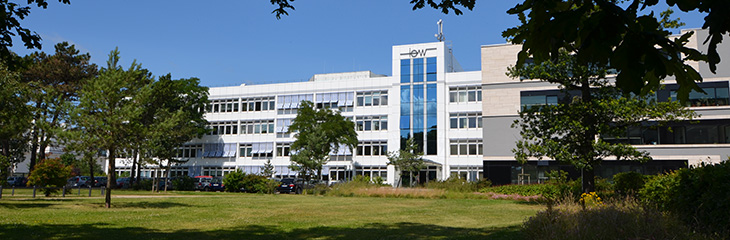
The IOW is divided into five departments: Physical Oceanography, Marine Chemistry, Biological Oceanography, Marine Geosciences and Marine Observation. The research is based on the ten-year research programme “Perspectives of Coastal Seas”, which comprises three interdisciplinary research areas.
All Departments
Department of Physical Oceanography
The Department of Physical Oceanography investigates processes in coastal and shelf seas, the dynamics of marine ecosystems, and climate variability of the Baltic Sea region. Through the development of numerical models for the ocean, the atmosphere and the land, the use of modern measurement techniques and long-term observations - particularly in the Baltic Sea - it contributes to a sound understanding of marine systems undergoing change.
Department of Biological Oceanography
The department of Marine Biologie studies the structure and function of marine communities in coastal and marginal seas, particularly the Baltic Sea, and investigates their responses to natural and anthropogenic environmental changes. Using experimental, observational, and model-based approaches, as well as modern molecular and biogeochemical methods, it analyzes biodiversity, element cycles, and trophic interactions, thereby contributing to a sound understanding of marine ecosystems in transition.
Department of Marine Chemistry
The department of Marine Chemistry investigates the distribution, transport and transformation of chemical compounds and elements in the ocean that are highly relevant to the environment, particularly in coastal waters. Researchers examine both dissolved and particle-bound substances using state-of-the-art chemical analytical methods, innovative oceanographic infrastructure and sensor technlogy. These methods, infrastructure and technology are further developed within the department.
Department of Marine Geosciences
The department of Marine Geosciences investigates the postglacial evolution of coastal and marginal seas - particularly the Baltic Sea - and examines key sedimentation processes as well as biogeochemical dynamics. Geophysical work provides insights into seabed structures and marine habitats, while our geographical research analyses the impacts of human interventions, policy frameworks, and adaptation strategies in coastal areas.
Department of Marine Observations
The Marine Observations department develops, maintains, and operates state-of-the-art ocean measurement systems. From autonomous MARNET stations and optical remote sensing to sophisticated ship-board instrumentation and advanced fabrication and calibration, the department provides the know-how, expertise, and capabilities that form the foundation for Baltic Sea research. Within the expedition technology team and the workshop, instruments and systems are built, maintained, and repaired in-house.