
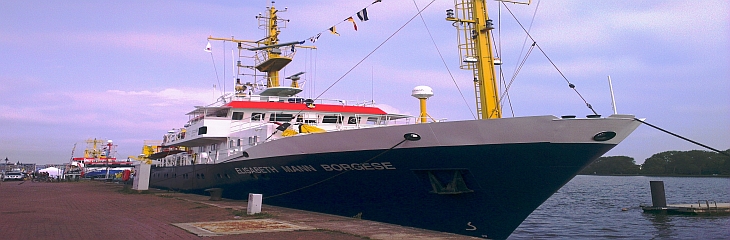
Working group Trace Gas Biogeochemistry
Dissolved gases play a central role in marine biogeochemistry. They link the ocean to the atmosphere, influence major biogeochemical cycles, and respond sensitively to environmental change. In our working group, we investigate the processes controlling the production, consumption, and transport of dissolved gases, their exchange with the atmosphere, and their significance as greenhouse gases and indicators of biogeochemical processes. A particular focus is on how human activities and climate change alter these processes. The development of new analytical and instrumental approaches is an essential part of our work, enabling us to advance these research questions, also at the international level.
Of particular relevance are the “big three” greenhouse gases: carbon dioxide, methane, and nitrous oxide. While the ocean represents an important sink for anthropogenic carbon dioxide, it is a net source of methane and nitrous oxide to the atmosphere. How these functions change depends on complex biogeochemical processes that are particularly strongly affected by human influences and climate change in dynamic coastal waters.
The carbon cycle provides a central link between primary production at the ocean surface and oxygen-dependent mineralization in the ocean interior. Understanding this cycle is therefore essential for describing and quantifying marine biogeochemical cycles. At the same time, the marine inorganic carbon system determines the acid–base properties of seawater and thus, seawater acidity (pH). A new focus of the working group is to investigate the extent to which targeted interventions or conservation measures can influence the uptake and storage of carbon dioxide by the ocean and coastal ecosystems.
Human influences can substantially alter natural greenhouse gase cycles, particularly in coastal waters. Increased nutrient inputs (eutrophication) can enhance primary production and, through subsequent remineralization, increase oxygen consumption. This, in turn, affects the production and consumption of redox-sensitive gases such as methane and nitrous oxide and may amplify undesirable feedbacks. At the same time, many biogeochemical processes are temperature-dependent and therefore directly affected by ongoing warming and other consequences of climate change. Understanding these interactions is thus essential for assessing future changes in marine biogeochemical cycles.
Dissolved gases can also serve as sensitive tracers of processes and transport mechanisms. For example, the N₂/Ar ratio can provide insights into nitrogen fixation and denitrification, while artificial gas tracers can be used to investigate vertical mixing and water-column ventilation. Such approaches allow us to quantify processes that are difficult to measure directly by other methods.
The working group is active in all three research areas of the IOW. Process studies investigate the mechanisms controlling the production, consumption, and transport of trace gases, as well as their significance for large-scale biogeochemical fluxes and transformation rates (Research Area 1). Long-term observations capture changes over extended timescales – including through the long-term monitoring programme, continuous measurements aboard the “Ship of Opportunity” Finnmaid as part of the European research infrastructure ICOS, and the use of BGC-Argo floats (Research Area 2). The development and advancement of analytical and instrumental methods, both within European networks and for specific research questions, constitute another major focus of the working group (Research Area 3). High dynamics in the very shallow coastal region motivate our engagement within the research cluster S2B.
The biogeochemistry of dissolved gases can only be understood by considering the interplay of different processes and compartments: sediments, transport and mixing processes within the water column, and predominantly microbially controlled transformation processes. The interdisciplinary structure of the IOW therefore provides a particularly well-suited environment for investigating these interactions, from the underlying processes to their effects on marine biogeochemical cycles and air–sea exchange.
Working group leader
Team
Scientist
Scientist
Dr. Damian Leonardo Arévalo-Martínez
Scientist
Scientist
Scientist
Scientist
Scientist
Technical staff
Dipl.Ing. (FH) Michael Glockzin
Technical staff
Technical staff
PhD student
PhD student